Another bank in Azerbaijan will introduce a Murabaha product
"International Bank of Azerbaijan" (IBA) will soon introduce a "Murabaha" loan for Islamic financing.
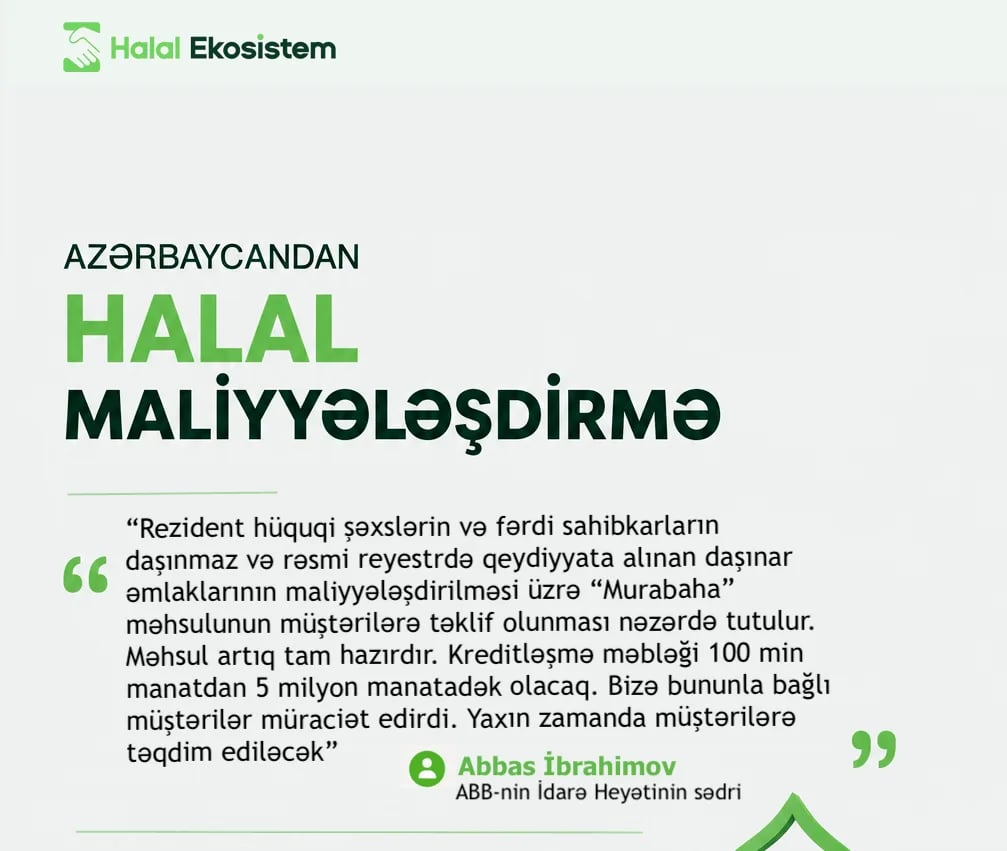
"International Bank of Azerbaijan" (IBA) will soon introduce a "Murabaha" loan for Islamic financing.
Abbas Ibrahimov, Chairman of the Management Board of IBA, said this at a press conference on the bank's sustainability report held on 08.05.2026 (yesterday).
According to him, the bank has developed a "Murabaha" product in connection with the opening of an Islamic banking window under the Central Bank's special regulatory regime.
“Under the special regulatory regime, it is planned to offer customers the "Murabaha" product for financing the immovable property, and the movable property registered in the official register, of resident legal entities and individual entrepreneurs. The product is already fully ready. The loan amount will range from 100 thousand manat to 5 million manat. We think it will be offered to customers soon,” he said.
On its website, IBA provides the following information about Islamic banking and its murabaha products:
What is Islamic banking and how does it differ from conventional banking?
Islamic banking is a financial system that operates in line with Sharia principles, is interest-free and is based on real assets. In this system, no interest is earned on money; financing is carried out through real goods and services.
What does the prohibition of interest mean in Islamic banking?
The prohibition of interest (riba) in Islamic banking means that money generating a return in itself is considered impermissible. That is, it is not permitted to demand additional income (interest) solely on the grounds that money has been lent.
If I pay early on an Islamic loan, is there a discount?
In Islamic banking (particularly in "Murabaha" transactions), the sale price is fixed and determined in advance when the contract is concluded. This price cannot later be increased or decreased.
Are penalties or late-payment interest applied in Islamic banking?
Late-payment interest is not applied in Islamic banking. However, in the event of a delay, a charitable penalty mechanism, which is not income for the bank, may exist.
How is the service fee calculated in Islamic banking?
In Islamic banking, the service fee is not interest but a fixed or cost-based charge that is based on the service actually provided and disclosed in advance.
How does Islamic banking ensure transparency?
Islamic banking ensures transparency through a fixed price disclosed in advance, transactions based on real assets, and the open sharing of risks.
Is collateral required for Islamic loans?
Yes, collateral may be required for Islamic financial products. This is not contrary to Sharia and is determined in line with the bank's risk policy.
For more information - https://cb.abb-bank.az/digital-platform/az/murabaha
It should be noted that, under the Central Bank's special regulatory regime, from 02.02.2026 for the next 1 year, "Rabitabank" OJSC is offering customers products for attracting funds from legal entities and individuals on a "Mudaraba" basis in line with Islamic banking principles, and for financing the fixed assets and working capital of business entities through the "Murabaha" mechanism.
History of Islamic banking at IBA (2011-2015)
The International Bank of Azerbaijan (IBA) began providing Islamic banking services in 2003. The bank provided these services using funds attracted from the Islamic Development Bank (IsDB) Group.
In 2011, the International Bank of Azerbaijan (IBA) announced a tender to engage an adviser for the creation of a specialised unit to offer Islamic banking products and services. The proposal to cooperate with a consortium made up of "Salans", "KPMG", "Pinsent Masons" and "Dar al Shariah" was unanimously accepted (Azertag, 2011). In September 2011, by decision of the Bank's Management Board, an Islamic Banking Department was created at IBA. Behnam Gurbanzada, who had previously worked as Deputy Director of the bank's Strategic Development and Marketing Department and as head of the Islamic banking implementation project, was appointed director of the department. The bank planned to begin financing individuals and legal entities and providing services to customers in January 2013.
In 2013, the creation of a specialised unit for offering Islamic banking products and services was supported by a consortium made up of "Salans", "KPMG", "Pinsent Masons" and "Dar al Shariah" (Trend.ru, 2015).
Under the "Introduction of Islamic banking" project it launched in 2012, the International Bank of Azerbaijan began providing Islamic banking services to individual and corporate customers from 2013. In 2014, in cooperation with institutions such as "Dubai Islamic Bank", "Barwa Bank", "Citigroup", "JP Morgan" and "Noor Bank", it raised a Sharia-compliant syndicated loan of 252 million US dollars. The bank's Islamic financial assets rose within a short period from 160 million dollars to 526 million dollars, and these figures accounted for 1.4% of the sector's total and 4.7% of IBA's assets.
The range of products offered by IBA included Ijara (leasing), Wakala (deposit investment), Islamic bank cards and "Qard al-Hasan" (interest-free loan) accounts. All these products were certified for Sharia compliance by the consulting firm "Dar Al Shariah", one of the subsidiaries of "Dubai Islamic Bank". However, Aliyev and Gasimov (2014, p. 137), relying on the official website of the "Islamic window", noted that some features of these products were disputable from the standpoint of Sharia principles. For example, the credit card service fee being tied to the card's limit and the fixed return on wakala-based deposits were cited as examples of such concerns (Madine, 2024).
IBA also agreed with the Bahrain-based consulting firm "Shariyah Review Bureau" and carried out the design of various projects, including a real estate project in Baku and a cash financing product. In addition, work was carried out on developing a Sharia-compliant student financing product (Reuters, 2014).
According to statements given to "Reuters" on 18 August 2014, the International Bank of Azerbaijan (IBA), Azerbaijan's largest lender, had begun preparations to set up a separate banking unit that would operate in accordance with Sharia rules. This initiative developed in parallel with the government's preparations for a draft law on Islamic banking, which was planned to enter into force in the spring of 2015 (such a law did not enter into force, and still has not)
At that time, IBA, 50.2% of whose shares belonged to Azerbaijan's Ministry of Finance, aimed to quadruple the existing volume of Islamic finance activity in the country through this independent unit (Reuters, 2014)
At that time, IBA, which held 40% of the country's banking assets, had carried out a total of 180 million US dollars of Islamic financing. Some other sources state that IBA's total Islamic finance portfolio was 526 million US dollars/ With the entry into force of the law, this figure was forecast to reach 750 million US dollars within a year.
In its current state, the bank offered Sharia-compliant products through an "Islamic window" model; this model allowed conventional banks to provide Islamic financial services on condition that customer funds were kept separate. However, the establishment of an independent unit was regarded as a strategic step that could increase the appeal of Islamic banking among retail customers.
One of IBA's goals was to create a strong national Islamic banking platform that could be used not only in Azerbaijan's domestic market but also in its subsidiaries in Russia, Georgia and Qatar. Gurbanzada even stated that Azerbaijan had the potential to become a regional Islamic banking centre. At that time, the Russian Banks Association had formally appealed to Moscow to create a sector-specific legislative framework for the development of Islamic finance in the country (Reuters, 2014).
In October 2015, IBA decided to wind down its Islamic banking activities for strategic and operational reasons. According to some sources, behind this decision lay a money laundering scandal involving IBA's Chairman of the Management Board, and the financial crisis that followed. Thus, in 2017, IBA was declared a "failed institution" (Madine, 2024).
Nevertheless, as of February 2016, expectations had been made public that the first independent Islamic bank in Azerbaijan could begin operating as early as 2017. Although this expectation was not realised in the short term, the process went down in history as an important stage in the development of the country's Islamic finance infrastructure (ICD, 2018).
Unfortunately, none of this happened. And years later, in 2026, we began to see practical results.
https://www.bbc.com/azeri/azerbaijan/2013/11/131126_islamic_bank_azerbaijan
Write a comment
Sign in to leave a comment. No password needed — we email you a one-time link.
Sign in
Comments
No approved comments yet.