Are Rewards in Digital Payment Apps Halal? (The Akart Example)
The various campaigns, gifts and "cashbacks" offered by digital payment systems and e-wallets often raise questions among users about whether they are halal.
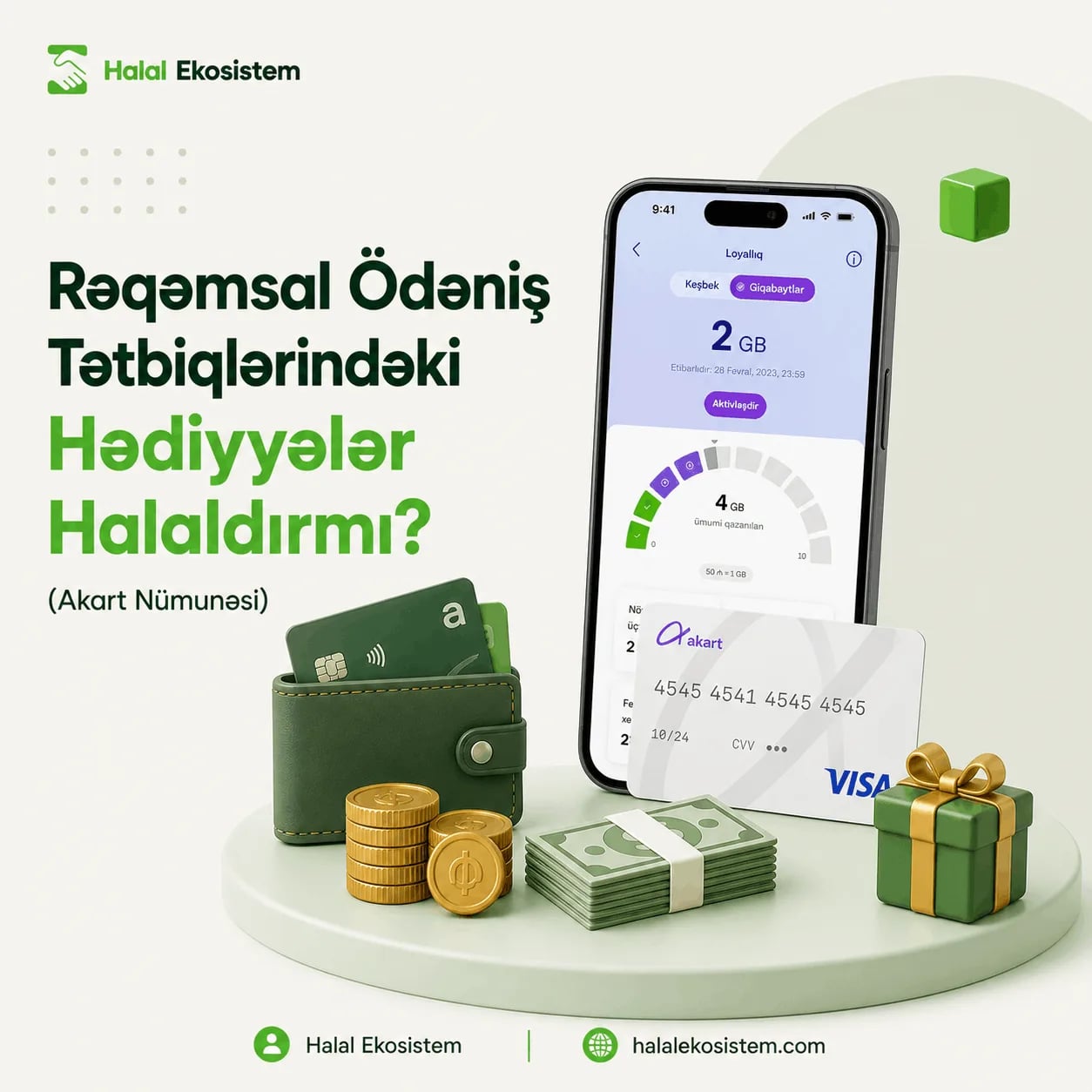
In the modern era, digital payment systems and electronic wallets (e-wallets) have become an inseparable part of our daily lives. However, the various campaigns, gifts and "cashbacks" these platforms offer often raise questions among users about whether they are halal. In this article, we analyze the place of digital payments in Islamic financial law through a concrete example.
1. The question we received: "In Azercell's Akart app, a 1GB internet package is given as a gift for every 50 AZN paid per month. Also, when making a 'Card to Card' (C2C) transfer with this card, the name of PASHA Bank appears in the system as the recipient. Is it permissible to use such apps and to receive the gift that is given?"
1. A Gift Given in Return for a "Payment" (Spending)
If you buy any service or goods worth 50 AZN through "Akart" (for example, a utility payment, grocery shopping, a mobile balance top-up, etc.) and Azercell gives you 1GB of internet as a gift in return, this is permissible.
- Fiqh basis: The mechanism applied in this case is called "Hibah" (gift) or a marketing incentive in Islamic law. You buy a service (or make a payment), and the company, because you used its infrastructure (because you earned it a commission), returns a part of its profit to you in the form of a service (internet). There is no direct interest (riba) or gambling here, because what exists is not a loan relationship but a trade/service relationship.
2. A Gift Given in Return for a Pure "Balance Top-Up"
If the gift is given merely because you deposit 50 AZN onto the card (load money) and keep that money on the card without spending it, this creates a risk of interest.
- Fiqh basis: In Islamic law, money deposited with a bank or an e-wallet is considered a "Qard" (loan). According to the rule: "Every loan that brings a benefit is interest." Therefore, do not accept, and stop, any extra gifts and payments given to you in return for money you load onto current accounts.
3. The Role of PASHA Bank and the Card-to-Card Question
"Akart" and other similar electronic money institutions (for example, m10) are non-bank financial organizations. Under the country's legislation, although electronic money institutions can issue electronic money and payment cards, they cooperate with banks in order to offer a number of financial services (such as e-commerce and transferring money to a card) to their customers.
- PASHA Bank is the financial and technological partner of Azercell's "Akart" project. Your money in "Akart" is kept at PASHA Bank, and the bank uses that money.
- When you make a "Card to Card" transfer, PASHA Bank's transit accounts operate behind the scenes of the system, which is why PASHA Bank appears as the recipient.
- From the fiqh perspective, there is no problem in your using PASHA Bank's service as a transit (intermediary). Your transaction is not taking an interest-bearing loan from PASHA Bank or lending money to them at interest; it is merely using their payment infrastructure.
Another question may arise here. If no extra interest or commission is charged to me, what do the bank (PASHA Bank) or Azercell earn from this?" The answer to this question lies in the core business model of modern financial technologies (FinTech) and digital banking.
Let us explain what they earn from, and how, in 4 main points:
1. Commission Received from Merchants
When you pay 50 AZN through "Akart" at any market, restaurant or online platform, exactly 50 AZN leaves your card. However, not all of that amount goes to the account of the market (the seller).
- For every digital payment it accepts, the seller pays the banking system a commission (roughly between 1.5% and 2.5%).
- That is, when you pay 50 AZN, PASHA Bank and Azercell earn approximately 0.75 - 1 AZN in commission (a service fee) from that seller.
- This is called a service fee or "Wakalah fee". The bank earns money not from you but from the seller, because it provides the payment infrastructure.
2. Free Liquidity and Management of the Money Supply
You and hundreds of thousands of users like you load money onto "Akart" (or other e-wallets) in order to make payments. Sometimes this money is not spent immediately and stays on the card for 1 day, 1 week or 1 month.
- The small amounts remaining on everyone's card (for example, 20 AZN each) are pooled together and create a "free" (or very cheap) money supply worth millions of manats in the bank's accounts.
- The bank uses this large liquidity in its other financial operations. They gain access to a huge capital without paying you interest.
3. Cross-Selling and Winning Customers
Today in the market, the advertising and marketing cost a bank incurs to attract a new customer is extremely high.
- Through the "Akart" project, PASHA Bank gains direct access to Azercell's millions of subscribers.
- Today you only load 50 AZN onto that app, but the bank has already brought you into its ecosystem. In the future, through that app you can buy insurance, open a business account or use the bank's other paid/commission-based services. The bank takes on the cost of that 1GB of internet today in order to "catch" you.
4. The Real Value of 1GB of Internet for Azercell
But why is exactly 1GB of internet given, and why is no cash (cashback) given?
- Because for telecommunications companies (after the infrastructure and antennas have already been built), the marginal cost of producing an additional 1GB of internet is almost zero. That is, the production cost of that 1GB to the company is not even one qəpik. But in the customer's eyes its value (when bought as a package) is perhaps 2-3 manats. By giving away a digital product that costs it nothing, the company binds you even more closely both to its app and to your number (the Azercell network).
Concrete conclusion: The bank earns from your transaction not interest, but an infrastructure service fee (the commission taken from the seller), a large database (Data) and cheap liquidity (money supply). Although this economic model is a very profitable mechanism for the parties, it is risky from the standpoint of halal status. Why?
Because PASHA Bank (or any other bank) takes the money (liquidity) you keep on your card and lends it to others as interest-bearing loans, earning a large profit from this.
❓This brings up the 3rd question:
According to Islamic law (fiqh), if you know for certain that a loan you give to a person will be used in a definitely haram matter (lending at interest, buying alcohol, gambling, etc.), is it permissible to lend to that person?
Answer: Absolutely not, it is not permissible (halal).
The religious and legal basis of this matter can be explained through the following 3 fundamental principles:
1. The Prohibition of "Assisting in Sin"
A fundamental rule in halal standards: Just as committing the haram is a sin, knowingly creating the conditions for the haram to be committed and acting as an intermediary is also a sin.
The greatest evidence for this is verse 2 of Surah Al-Ma'idah of the Quran:
"...Help one another in doing good and in refraining from evil (in taqwa). Do not help one another in committing sin and in enmity..."
If that person would not be able to carry out an interest transaction or buy alcohol unless you lent to him (or if doing so would become difficult for him), the money you give is regarded as the direct "fuel" of that sin. Even if you give the money with a good intention, you bear responsibility because you know the outcome.
2. Closing the Paths Leading to Evil (Sadd al-Dhara'i)
There is a well-known fiqh rule in Islamic law: "The means to the haram is also haram." For example, selling grapes is in itself entirely halal. However, the majority of Islamic scholars state that if you know for certain that a person will make wine from those grapes (prepare alcohol), selling grapes to him is haram. The same logic applies to lending money: Giving money is halal, but giving it knowing that alcohol will be bought or that it will be lent at interest is haram.
3. The Factor of "Certain Knowledge" (Certainty)
The most important nuance in your question is the expression "know for certain". In Islamic law, the ruling differs according to a person's intention:
- If you know for certain: As we mentioned above, giving is absolutely not permissible.
- If there is strong suspicion: If a person's way of life rests solely on the haram (for example, if he is a professional usurer or has a chronic alcohol addiction) and what he will spend the money on is evident, lending is still considered makruh (disliked) or haram.
- If you have no knowledge or only a weak suspicion: If a person simply asks for money saying "I am in need" and you do not know what he will do with it, lending is halal and rewarded. Islam does not require us to investigate people's hidden intentions.
When faced with such a situation, refusing to give the money both protects your own religious responsibility (your hereafter) and is important in terms of keeping the other party away from committing that sin (or at least not becoming a partner in his sin).
So do we not know for certain that banks will use the money they take from us for haram purposes?
Islamic scholars permit the use of bank cards only on the basis of certain conditions.
Namely, fiqh sets a very strict boundary: If you put onto Akart or a salary card only as much money as your daily/monthly needs (payments), and this money sits there for transit purposes, this is halal out of necessity. BUT, if you keep a large sum (for example, 1,000 AZN that you do not need) in that bank's current account for months without any necessity, merely so as not to keep it at home or for some other reason, according to the great majority of scholars this is no longer permissible. Because the excuse of "necessity" is now removed, and you knowingly offer your large capital to the bank's interest operations as free "fuel".
Write a comment
Sign in to leave a comment. No password needed — we email you a one-time link.
Sign in
Comments
No approved comments yet.